Paper trading for beginners
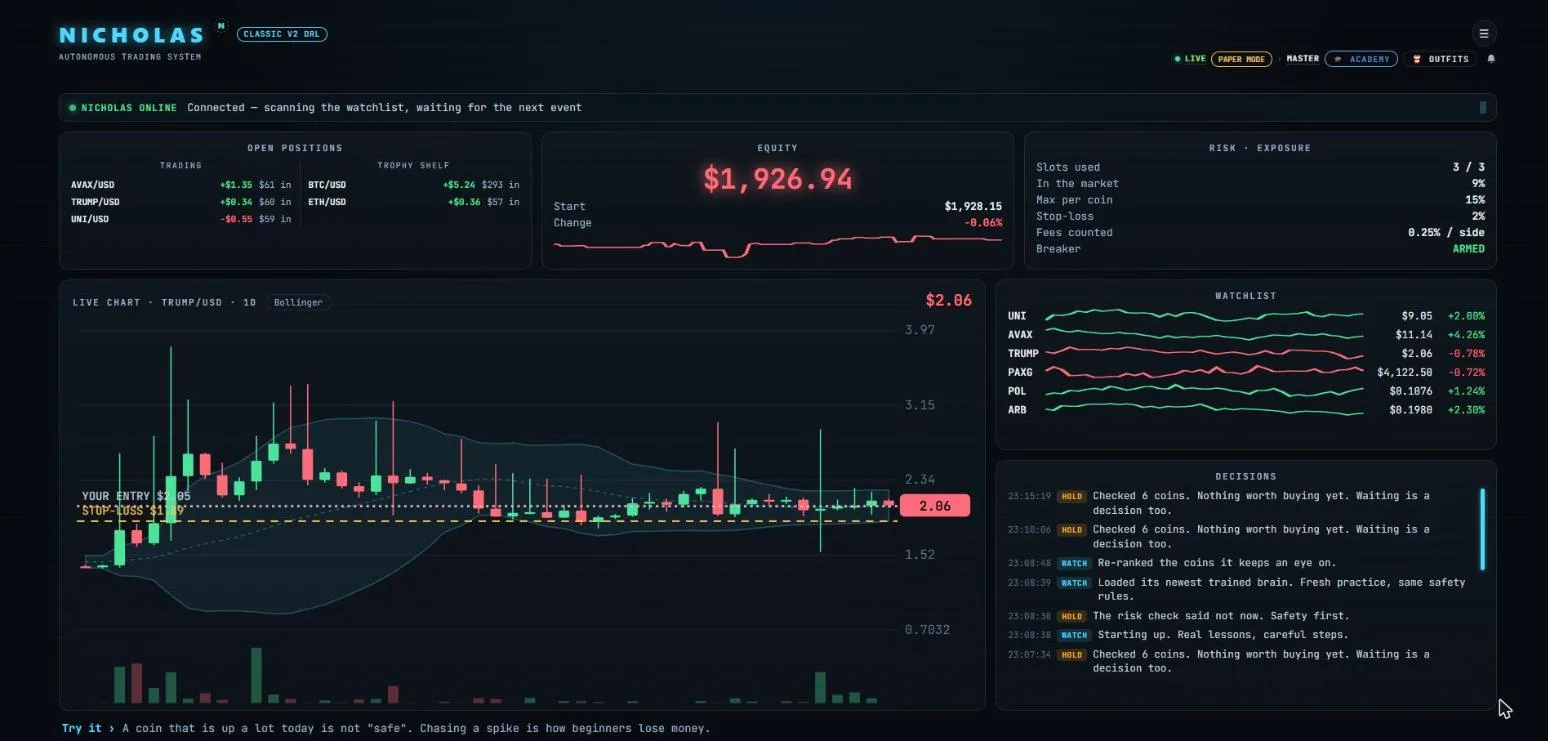
Paper trading means trading with pretend money in a real market. Real prices, real charts, zero risk. It's the flight simulator of investing.
Why start on paper?
Because the first lessons in trading are expensive. Paper trading lets you learn what a stop-loss feels like, what a losing week looks like, and how often a bot just sits and waits, without paying for those lessons in real money.
Alpaca, the broker Nicholas works with, gives every account a free paper account. Nicholas always starts there.
The catch: paper flatters you
Paper results usually look better than real ones would. Three reasons:
- No fees. Alpaca's paper account doesn't charge crypto fees, but a real account does (about 0.15% to 0.25% per trade). Nicholas estimates those fees and shows them anyway, so the number you see is closer to what real money would have done. More on that in fees, explained.
- Perfect fills. On paper your order always fills at a fair price. In real markets you sometimes pay a bit more.
- No nerves. Watching pretend money drop 5% is easy. Watching real money drop 5% is not.
How to paper trade well
- Use a realistic amount. Practise with the amount you'd actually invest, not a million pretend dollars.
- Give it weeks, not days. A few lucky trades mean nothing. Watch through good and bad days.
- Count the fees. Always look at results after fees.
- Learn the screen. Tap every box in Nicholas until each number makes sense to you.
- Write down what surprised you. That's where the learning is.
When to move to real money
Only when you understand what the bot does, you've watched it through a losing stretch without wanting to pull the plug, and you're using money you can afford to lose completely. Crypto can lose value very quickly.