What is a crypto trading bot?
A crypto trading bot is a program that buys and sells crypto for you, following rules, around the clock. That's it. No magic, no crystal ball.
The short version
You connect the bot to your account at a broker or exchange. The bot watches prices, and when its rules say "now", it places an order, just like you would by tapping Buy or Sell yourself. Crypto markets never close, so a bot can keep watch at 3am when you're asleep.
What a bot actually does, step by step
- Watches. It reads prices for a few coins, often once a minute or once an hour.
- Decides. It checks its rules. "Has the price dropped unusually far?" "Is the trend up?" Some bots use fixed rules; others use a machine-learning model.
- Sizes. A good bot decides how much to buy from how much it is willing to lose, not from how excited it is.
- Places the order and sets an exit, usually a stop-loss.
- Waits. Most of the time, the right answer is to do nothing.
What a bot can't do
- It can't see the future. Nobody can. A bot that promises steady profits is selling you something.
- It can't avoid fees. Every trade costs a little, and those costs add up fast. See crypto fees, explained.
- It can't fix a bad idea. A bot follows its rules perfectly, including bad rules.
Rules-based vs. machine-learning bots
A rules-based bot follows instructions a human wrote, like "buy when the price closes above its 20-day high". A machine-learning bot learns its own rules from past price history. Nicholas uses machine learning (deep reinforcement learning): its model is retrained every week, and a new version is only used if it made money after fees on recent data it had never seen. That's a small test, not proof. Past results don't promise future ones.
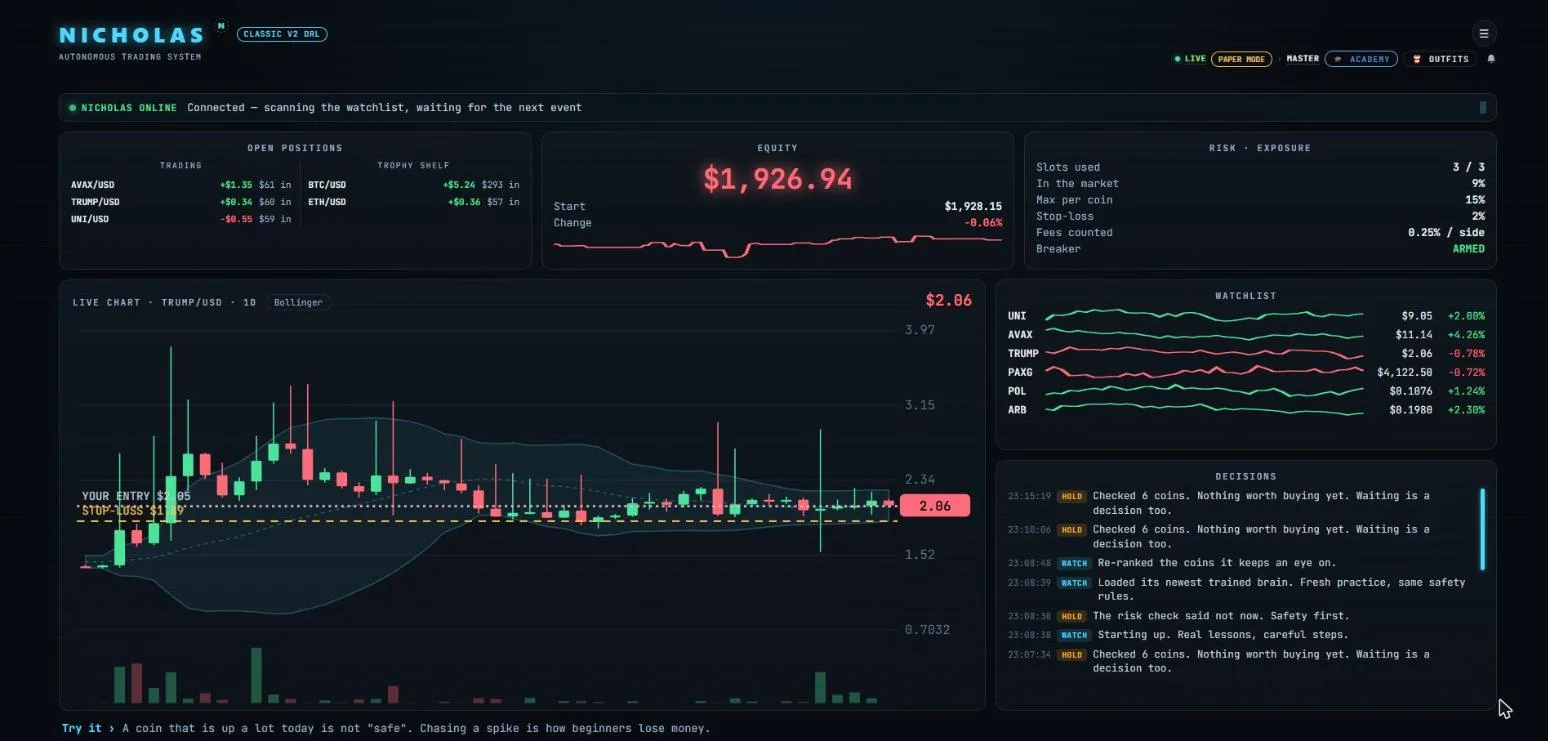
How Nicholas is different
Most bots are built for people who already trade. Nicholas is built for people who never have. Every box, number and coin on the dashboard has a tap-to-hear explanation in plain words, and there's an Academy mode that teaches the basics (candles, Bollinger bands, RSI, MACD and ATR) one unit at a time. It starts on a paper account with pretend money.